- Home
- >
- Activities
- >
- The Gallery of the New university
- >
- Exhibitions
- >
- Exhibition of paintings by Jožica Medle and Céline Geeraert: Old stories, new times
Exhibition of paintings by Jožica Medle and Céline Geeraert: Old stories, new times
As part of a series of solo exhibitions featuring carefully selected and highly diverse visual artists, the current exhibition at the New University Gallery establishes not only a dialogue between artworks and viewers, but also a dialogue between two women artists, Céline Geeraert and Jožica Medle.
Céline is from Belgium, and Jožica is from Slovenia. The two artists belong to different cultural contexts, yet each is distinguished by an intimate artistic vision that is highly personal, distinctive, and unique. Despite their differences, they share a common thematic starting point centred on the human being. Their works reveal a multilayered interest in humanity and an awareness of constant change. Both engage with old stories that return through time in new forms and variations, thereby preserving the primal, fundamental, and timeless essence of human existence.
Céline defines her visual language as organic, playful, and multilayered. It is at once fragile and resilient, constantly evolving yet persistent. Her artistic vocabulary serves as both metaphor and objectification of the themes she explores. Over the years, the same materials, forms, and motifs have returned in her works, each time in a new constellation. Like life itself, her work is constructed from recurring elements that, whenever newly assembled, come together to form an original whole.
In her artistic practice, she moves from line to form, from drawing to three-dimensional object. Her creative impulses arise from personal experiences, impressions, sensations, emotions, ideas, and reflections that unfold across a broad spectrum and provide the foundation for the creation of her works. Yet creative acts always return to a primordial form. This fundamental impulse is represented by the motif of the womb, from which both visual and conceptual life emerges. It is a form that symbolises fundamental equality. An original form that has become archetypal in Céline’s work. She derives from it, varies it, and realises it through different media. It provides both a point of departure and an anchor to which she returns. It is a metaphor for life itself. The womb is more than the form of an organ: it is a symbol of a space in which an idea—the embryo—grows in a particular intimacy, nourished by the artist’s energy, before being born and manifested to the world. The artist’s role is thus realised as a delicate balance between creating from the deepest part of oneself and having the courage to release what has been created, to share it, and to relinquish it as an independent artistic entity to the collective cultural dialogue. In symbolic and artistic terms, the womb represents one of the most powerful, ancient, and complex archetypes in human culture. It transcends its purely biological function and touches upon questions of existence, consciousness, transience, and rebirth. Céline presents it in an authentic way. For her, the final result is not the only thing that matters; the entire creative process is equally important. This process represents a transition from the inner to the outer, from the personal to the collective, from an idea to material presence.
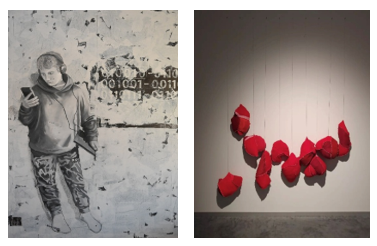
Jožica Medle’s creativity likewise emerges within the safe, intimate shelter of her inner world. Although removed from current artistic trends, her work is profoundly sensitive and deeply responsible towards humanity and the world. Her works are visually sophisticated chronotopes in which her personal experience of the world unfolds through space and time, within herself and around her. An extraordinary creative vitality drives her towards a constant search for new solutions, each increasingly profound and visually refined. Her practice is a visual game—a game of considered and meaningful gestures. She is an accomplished printmaker and an equally compelling painter. Her transitions between these two fields are assured, while their interweaving is particularly interesting because, despite their interconnectedness, each discipline retains its autonomy. Both in her thinking and in her creative acts, we follow a development that is organic. Her works are marked by a sensitive, feminine nature that is at the same time unyieldingly strong in its authorial character. The visual means, methods, and approaches she employs enable her to create a convincing personal artistic world in which she does not describe but rather expresses her views, feelings, and reflections. Her art arises from an inner necessity: to empower her statement, convey an insight, reveal an attitude, and articulate an appeal.
Her most recent works, too, represent a profound and multilayered encounter with visual means of expression and with the human being. They appear like sequences from a film of life, in which scenes reflect a reality that can be perceived and, in an associative, metaphorical, and symbolic manner, embodied only by an artist as subtle as Jožica Medle. In her paintings, black and white, light and darkness come together as counterpoints that objectify the eternal analogies of life. In her paintings, the human being is an actor within the unfolding drama: a boy equipped with contemporary technological devices; a girl standing before ruins that bear witness to the horrors of our present time; … or, at other times, human presence is conveyed solely through writing. Jožica is interested in the evolution of humanity and its social, societal, and technological dimensions. She pauses at writing, an invention that has left a particularly profound mark on human history. Writing has had extraordinary civilisational significance, while at the same time being something deeply personal, both in terms of content and form. A hand-created trace carried the individuality of its author, their way of thinking, and their physical presence. Today, letters are multiplied impersonally and without limit. Words and their combinations are no longer necessarily expressions of an individual, but may instead reflect artificial intelligence. This raises a question that extends beyond technology itself: how many new tools have appeared throughout human history, and how many revolutionary changes have they brought about? More importantly, we should ask whether these tools help us, or whether we allow them to direct and overpower us, gradually taking away what is most intimate—our individuality, creativity, and identity. In her paintings, the artist holds up a mirror to us. Change is an essential part of development, but development requires vigilant and attentive people. Jožica Medle is both vigilant and deeply sensitive. With care and responsibility for the present and the future, she lives out her artistic vocation. With their balanced internal structure, their real and realistic elements accompanied by considered visual solutions, and their artistic singularity and grandeur, her works become deeply communicative and relevant, noticeable precisely in their understated nature.
We can follow Céline Geeraert and Jožica Medle on artistic paths that begin from a related point of departure but develop into two entirely different artistic interpretations. Yet in both there is an awareness that life is constantly changing while simultaneously returning again and again to the fundamental questions of its existence. Alongside the black-and-white orchestration of their works, red also appears. It is not merely a chromatic accent, nor simply a fil rouge, but becomes a symbol of the essence they contemplate—a symbol of life, which they bring into being both visually and conceptually. And regardless of the language of their expression, they invite us to engage in profound reflection on Life.
Experiences of reality have become works of art. The individual becomes universal.
Anamarija Stibilj Šajn, Art Critic