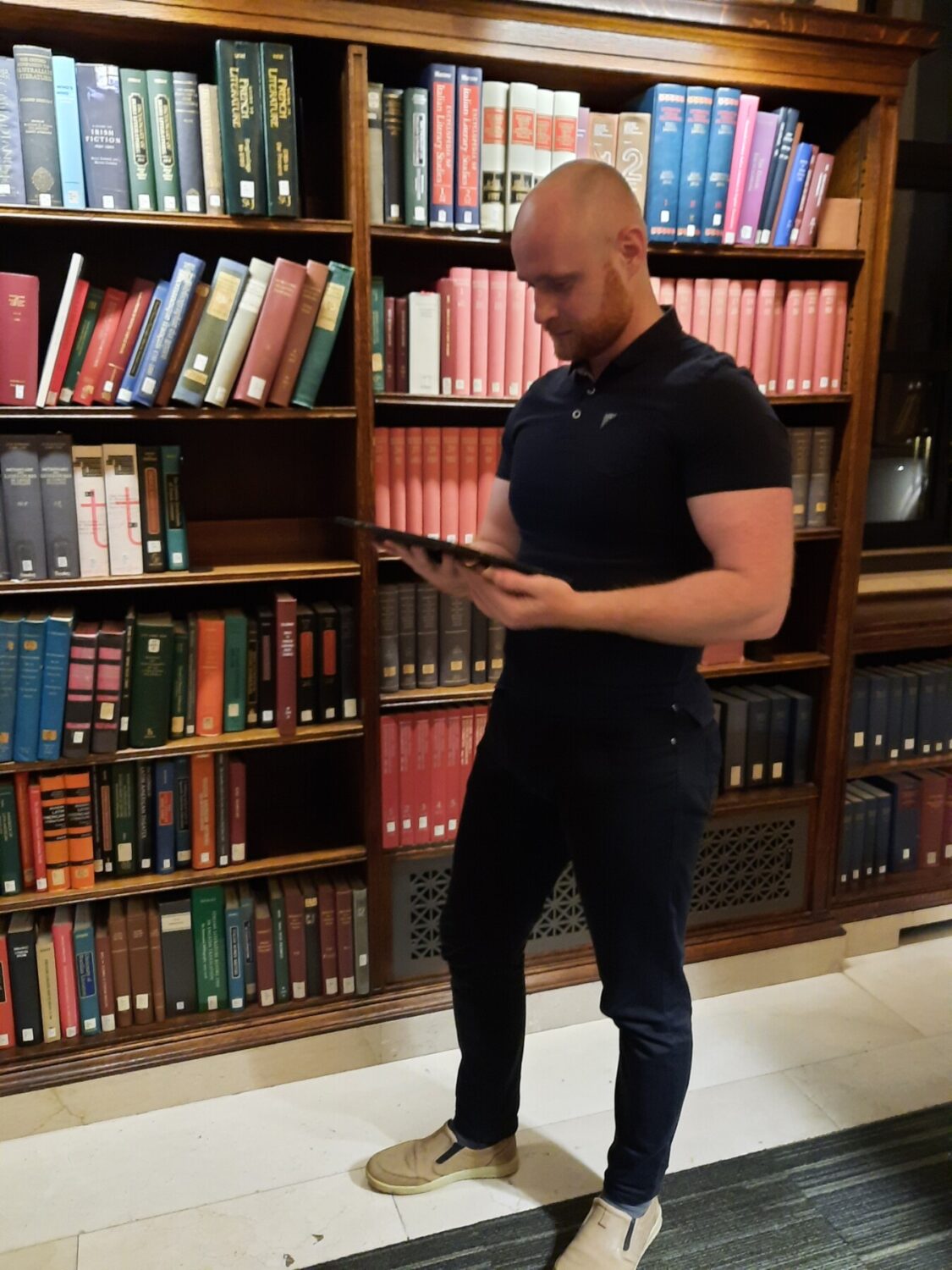
doc. dr. Izidor Janžekovič Visokošolski učitelj
Doc. dr. Izidor Janžekovič je profesor za pomorsko, kulturno in globalno zgodovino zgodnjega novega veka. Na Novi univerzi vodi temeljni raziskovalni projekt z naslovom Percepcije etničnih identitet in stereotipiziranje v zgodnjem novem veku med Sredozemljem in Srednjo Evropo (ARIS J6-70245). Nedavno je doktoriral summa cum laude iz primerjalne zgodovine na Srednjeevropski univerzi na Dunaju in v Budimpešti pod mentorstvom profesorja Lászlója Kontlerja. Prejel je prestižno Fulbrightovo štipendijo za študij na Univerzi Harvard, kjer je raziskoval pod mentorstvom profesorja Davida Armitagea. Poleg tega je bil predavatelj za globalno zgodovino na Princetonu in Sapienzi v Rimu v okviru projekta Global History Lab, ki ga vodi profesor Jeremy Adelman. Prav tako se je raziskovalno izpopolnjeval na Univerzi v Sheffieldu, na Fondazione Giorgio Cini v Benetkah, na Univerzi v Leidnu pod mentorstvom profesorjev Michiela van Groesena in Jeroena Duindama ter na King’s College v Londonu pod mentorstvom profesorja Andrewa Lamberta. V Ljubljani je vzporedno študiral arheologijo pod mentorstvom profesorice Katarine Katje Predovnik in zgodovino pod mentorstvom profesorja Marka Štuheca ter iz obeh disciplin diplomiral in magistriral; za magistrsko nalogo je prejel Prešernovo nagrado in nagrado za najboljšega študenta Mestne občine Ptuj. Prav tako je uspešno zaključil magisterij iz zgodnjenovoveške evropske in britanske zgodovine na Univerzi v Oxfordu pod mentorstvom profesorja Davida Parrotta. Svoje študije objavlja v prestižnih domačih in tujih revijah, in sicer za Zgodovinski časopis, Annales, International Journal of Maritime History, The History of Political Thought, Journal of Anthropological Archaeology, Journal for Maritime Research, History of European Ideas in History and Anthropology.
Assist. Prof. Izidor Janžekovič is Professor of maritime, cultural and global history of the early modern era. At the New University, he leads a fundamental research project entitled The Perceptions of Ethnic Identities and Stereotyping in the Early Modern Era between the Mediterranean and Central Europe (ARIS J6-70245). He defended his PhD in comparative history (summa cum laude) at the Central European University in Vienna and Budapest under the supervision of Professor László Kontler. He received a prestigious Fulbright scholarship to study at Harvard University, where he conducted research under the supervision of Professor David Armitage. In addition, he was a lecturer in global history at Princeton and Sapienza in Rome as part of the Global History Lab project, led by Professor Jeremy Adelman. He also completed research training at the University of Sheffield, the Fondazione Giorgio Cini in Venice, the University of Leiden under the supervision of Professors Michiel van Groesen and Jeroen Duindam, and at King’s College London under the supervision of Professor Andrew Lambert. In Ljubljana, he studied archaeology under the mentorship of Professor Katarina Katja Predovnik and history under the mentorship of Professor Marko Štuhec, and graduated and received his master’s degree in both disciplines; for his master’s thesis he received the Prešeren Award and the award for the best student of the City of Ptuj. He also successfully completed his master’s degree in early modern European and British history at the University of Oxford under the mentorship of Professor David Parrott. He publishes his research papers in prestigious journals, namely Zgodovinski časopis, Annales, International Journal of Maritime History, The History of Political Thought, Journal of Anthropological Archaeology, Journal for Maritime Research, History of European Ideas and History and Anthropology.
- ‘No Escaping Brutal Reality: The Death Penalty in Early Modern Utopias,’History of European Ideas51 (2025): 711–738. Open Access: https://www.tandfonline.com/doi/full/10.1080/01916599.2024.2430956.
- ‘The Balance of Sea Power in the Early Modern Era: the Anglo-Dutch Wars,’ International Journal of Maritime History 36 (2024): 799–824. Open Access: https://journals.sagepub.com/doi/10.1177/08438714241269611.
- ‘Ethnic ‘stereotypes’ in early modern Europe: Russian and Ottoman national costumes,’ History and Anthropology 35 (2024): 500–524. Open Access: https://www.tandfonline.com/doi/full/10.1080/02757206.2022.2132494.
- ‘The Balance of Power from the Thirty Years’ War and the Peace of Westphalia (1648) to the War of the Spanish Succession and the Peace of Utrecht (1713),’ History of European Ideas 49 (2023): 561–579. Open Access: https://www.tandfonline.com/doi/full/10.1080/01916599.2022.2077401.
- ‘“To hell with everything”: Post-war nationalism and the “Old Slavic Sanctuary” at Ptuj Castle, Slovenia,’ Journal of Anthropological Archaeology 63 (2021): 1–14. Open Access: https://www.sciencedirect.com/science/article/pii/S0278416521000428.
- ‘The Elgin marbles: legitimate expatriation or urgent repatriation?’. Law & History Review, The Docket 4 (2021). Open Access: https://lawandhistoryreview.org/article/the-elgin-marbles-legitimate-expatriation-or-urgent-repatriation/.
- ‘The Rise of State Navies in the Early Seventeenth Century: A Historiographical Study,’ Journal for Maritime Research 22 (2020): 183–208. Open Access: https://www.tandfonline.com/doi/full/10.1080/21533369.2020.1835229.
- ‘The History of Masculinity in the British Atlantic World,’ Acta Histriae 28 (2020): 99–126. Open Access: https://www.dlib.si/details/URN:NBN:SI:DOC-V0NJA736.
- ‘The Balance of Power in the Renaissance,’ History of Political Thought XL (2019): 607–630. Open Access: https://www.academia.edu/111195036/The_Balance_of_Power_in_the_Renaissance.
- ‘A Series of (Un)Fortunate Events: The Elgin Marbles,’ The Journal of Art Crime 16 (2016): 55–76. Open Access: https://www.academia.edu/30711021/The_Elgin_Marbles_A_Series_of_Un_Fortunate_Events.